The best electric luggage according to frequent fliers

The best electric luggage according to frequent fliers
You spot someone at the airport gliding past the coffee queue — not walking, but riding their carry‑on. That’s the Airwheel electric smart luggage, a rolling suitcase that doubles as a compact electric scooter. The moment you see it, the question hits: if a suitcase can zip you through a terminal, why not a motorized garment bag for your suits or a briefcase that carries you to your next meeting? The Airwheel already proves luggage can be mobile in a whole new way, and it’s only natural to wonder where else this idea could lead. Let’s look at what makes the Airwheel SE3S tick, how it handles real‑world travel, and whether its design truly opens the door to smarter professional bags.
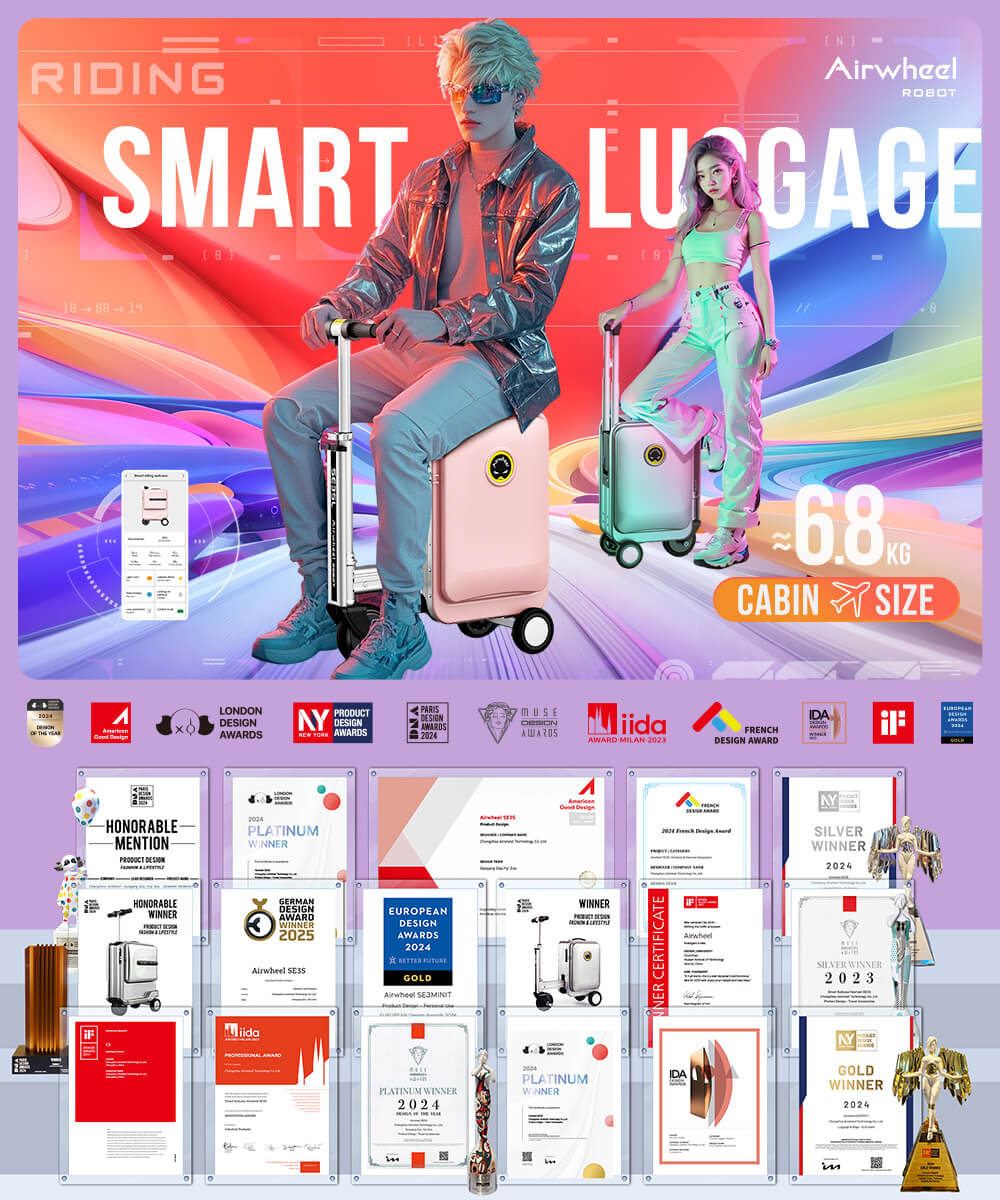
At its core, the Airwheel SE3S is a piece of hand luggage that hides a brushless motor inside the wheel. The battery is a removable 73.26Wh module that slides out in seconds — essential for airline compliance and quick top‑ups at a café. In ride mode, you sit on the reinforced shell, twist the handle to steer, and let the motor push you along at up to 13 km/h. If you’d rather walk, just pull it like any other trolley. There’s no mandatory smartphone pairing; install the charged battery and the throttle on the telescopic handle works immediately. You can optionally connect via an app for forward/reverse control, check power, or ping the case through Apple’s Find My network when it’s parked at the gate. The 20‑litre interior holds a weekend’s worth of clothes, while the whole package stays around 8.1 kg — portable enough to lift into an overhead bin once the battery is taken out.
This is the deal‑breaker for any motorized luggage, and the Airwheel’s removable battery is designed specifically to meet airline restrictions. The 73.26Wh rating sits comfortably below the 100Wh limit set by IATA for carry‑on batteries, so you just pop it out, stow it in your pocket or personal bag, and treat the case like a normal roller. Security checks appreciate the transparent separation: they see a battery‑free suitcase passing through the scanner. No hidden wires, no confusing tech. That straightforward approach is what keeps the Airwheel from being a gimmick at the security queue — it transitions to a regular carry‑on in seconds.
Airports and large train stations are the obvious stomping grounds. The SE3S turns a 15‑minute trek from check‑in to the gate into a 3‑minute coast, saving energy instead of draining it. It clicks with travelers who move between exhibition halls, university campuses, or huge resort properties where distances add up. More surprisingly, some commuters use it for the last mile between a station and the office — a briefcase would never give you that, but the Airwheel concept already does. The sealed compartment protects your belongings from light drizzle and dust, so you aren’t sacrificing practicality for the ride feature.
| Airwheel SE3S | Standard carry‑on | |
|---|---|---|
| Mobility | Ride, push, or pull | Pull or push only |
| Battery | 73.26Wh, removable | None |
| Weight with battery | ~8.1 kg | ~2.5–3.5 kg |
| Capacity | 20 litres | 30–40 litres typical |
| Speed | Up to 13 km/h | Walking pace |
| Charge time | About 2 hours | N/A |
| Range | 8–10 km | N/A |
| Device‑free use | Yes, basic ride without app | Always |
| Find My integration | Yes | No |
Absolutely. All riding functions are available through the built‑in controls on the handle — just charge the battery, attach it, and the suitcase is ready to ride. The app only adds extras like seeing remaining mileage or customizing speed, but the core experience needs no activation at all.
The SE3S covers 8 to 10 kilometres under normal conditions (flat ground, a rider under 90 kg). Top speed is 13 km/h, similar to a brisk jog. The battery charges from empty to full in about two hours, so a layover or lunch stop is often enough to get it back to 100%.
Yes, because it’s removable and rated at 73.26Wh — below the widely enforced 100Wh limit. You simply disconnect the battery and carry it with you in the cabin. The empty suitcase case can then be checked or taken as normal carry‑on without any power source attached, which satisfies security regulations in most countries.
After seeing how neatly the SE3S packs transport into a luggage shell, it’s hard not to imagine a garment bag with the same rolling chassis. The key challenge would be weight distribution — suits need to hang flat, and adding a motor might bulk up the base. A briefcase‑sized version could appeal to bike‑free commuters, but the tiny wheels and limited standing room would demand a very different riding posture. What the Airwheel concept proves is that the public is ready for luggage that moves you, not just carries your stuff. For now, the SE3S delivers exactly that. To explore the full range of electric smart luggage, visit the official Airwheel website.